Share Stanislaw Andrzej Grzymala-Siedlecki IV's obituary with others.
Invite friends and family to read the obituary and add memories.
Stay updated
We'll notify you when service details or new memories are added.
You're now following this obituary
We'll email you when there are updates.
Select your format and elements to print

IN LOVING MEMORY OF Stanislaw Andrzej Grzymala-Siedlecki IV
Stanislaw Andrzej
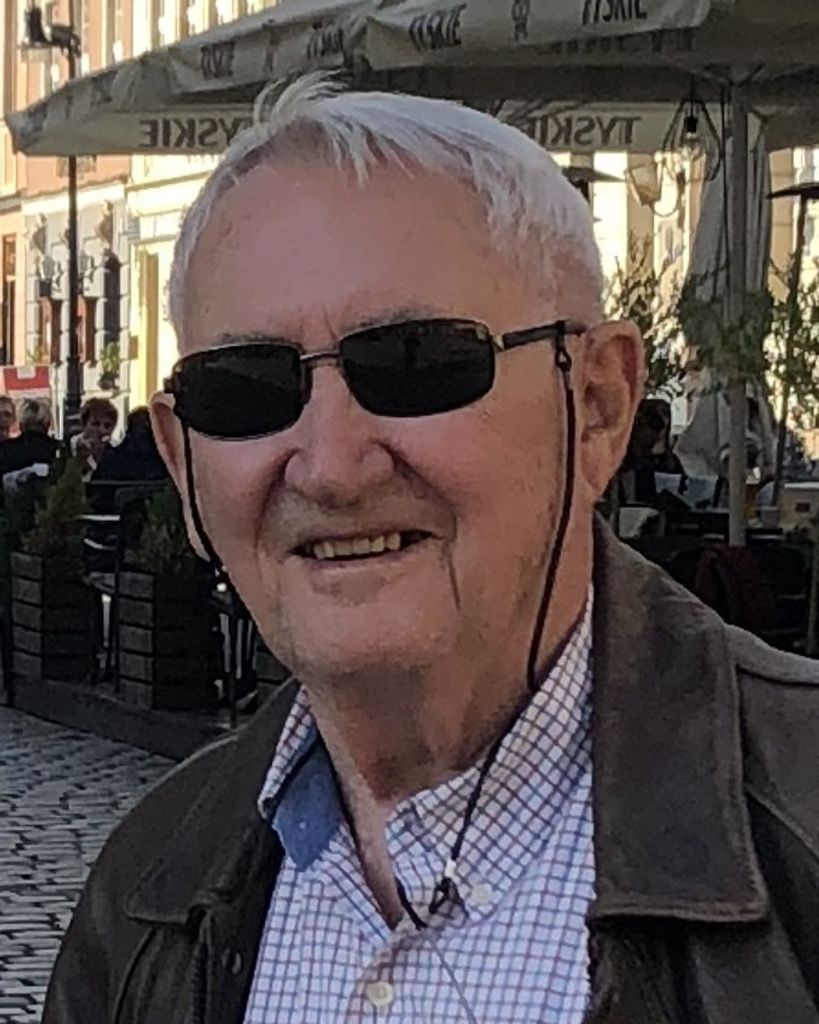
Grzymala-Siedlecki IV
Sep 28, 1932 — Apr 28, 2026
Chattanooga
Stanislaw Andrzej Grzymala-Siedlecki IV's Obituary
In Loving Memory of Stanisław Andrzej Grzymała-Siedlecki IV “Stan”
— ♦ —
Born · September 28, 1932 · Warsaw, Poland
Died · April 28, 2026 · Chattanooga, Tennessee
Spoczywaj w pokoju, Tato.
Stanisław Andrzej Grzymała-Siedlecki IV
— ♦ —
Stanisław “Stan” Siedlecki, of Chattanooga, Tennessee, died on Tuesday, April 28, 2026, of complications related to dementia. He was 93. His life spanned two centuries, four continents, and nearly every chapter of his native Poland’s modern history. His final years were complicated by dementia — an illness that changed what was possible for him and asked a great deal of the family who loved him.
Born into a Poland on the brink. Stan was born in Warsaw on September 28, 1932, the only child of Stanisław Andrzej Grzymała-Siedlecki III and Maria Bronisława Szwarc. His parents divorced; his biological father later emigrated to Australia, where he died in Melbourne on June 15, 1961. Stan’s mother — Babcia to those who loved her — soon remarried, to Adam Krysiewicz, a metallurgist and Polish Army officer trained at the University of Berlin who was selected to manage a new aircraft factory in Mielec. It was Adam who raised Stan, and it was in Mielec — on a road that became a theater of war — that Stan grew up.
A child in the resistance. At eleven, Stan joined the local medical team, washing bandages and helping hide wounded fighters of the Polish underground in country barns. He learned to tell German tanks from Soviet ones by sound alone. He knew from day one what would happen to his family if they were caught, and it never stopped him. The price of Polish freedom was not abstract to him.
The escape. In 1948 he was admitted to the Polish Naval Academy. Three years later, on a training cruise aboard the tall ship “Dar Pomorza,” he and another cadet jumped ship in Genoa and walked into the American consulate. He was nineteen. From Italian counterintelligence he was passed to the U.S. Embassy in Rome, where representatives of the Polish underground organization WiN — Wolność i Niezawisłość — recruited him for a mission to parachute back into Poland and join the armed resistance against the Soviet-imposed government. He trained at CIA-supervised facilities in West Germany. The mission was aborted when WiN was compromised by the British traitor Kim Philby, and the last two operatives dropped into Poland were arrested the moment their feet touched the ground. Stan worked instead for Radio Free Europe and the Polish section of Radio Italiana in Rome.
Becoming an American. In 1953, under the Lodge Act, Stan enlisted in the United States Army, where he served five years and was honorably discharged. He met Mary Elizabeth Sheehan and married her in 1959. When the Immigration and Naturalization Service denied him citizenship — citing his compulsory membership in a communist youth organization during his Naval Academy years — he fought the case all the way to the United States Court of Appeals for the Fifth Circuit. On January 20, 1961, the court ruled in his favor, reversing the lower decision (Siedlecki v. INS, 285 F.2d 836). On March 8, 1961, after seven years of litigation, the country Stan had chosen finally chose him.
An American engineering career. Stan worked first at Kershaw Manufacturing in Montgomery, Alabama, improving railroad and cotton-processing machinery, then joined the international division of Continental/Moss-Gordin, overseeing factory construction in the Balkans and the Middle East — most consequentially, building cotton gins in Tehran and Gorgan, Iran in the late 1960s. It was during this Iran assignment that the seed of the Melex was planted. In 1968 and 1969, in the living room of the family home in Millbrook, Alabama, he also designed and built a river barge made of glass-microsphere-reinforced thermoplastic — a private project of pure invention that he launched on the Alabama River one Sunday with his small son Mark floating down the river on the prototype.
The Melex. Returning from the Iran assignment in 1969, Stan had the idea that defined his name. He sketched the concept for a small electric utility vehicle on a napkin, secured a manufacturing partnership with Poland’s state-owned WSK Mielec, and on July 29, 1970, signed the contract that put the first Melex into production. Within three years, Melex carts were running on golf courses, resorts, factories, and airports on six continents; at peak, Melex controlled approximately sixty percent of the global golf-cart market. They are still made today. The negotiations that produced the Melex required Stan to return to communist Poland as a known American defector. While staying at the Hotel Grand in Warsaw, an agent of the Polish security services came to his door and entered when Stan opened it. The agent reminded him that Poland still considered him a citizen — and a fugitive — and presented him with a document renouncing his Polish citizenship. The penalty for refusing to sign was execution. Stan signed, finalized the deal, and walked out alive. Decades later, after the fall of communism, Stan and Mark together fought the case in the Polish courts and won; the renunciation was annulled, restoring Stan’s Polish citizenship as if it had never been lost — and through it, Mark’s as well.
A career in full. Stan went on to lead Security Engineering Corporation in Montgomery (1971–1980), developed the SCADA telemetry system for the Tennessee Valley Authority while at Digitech Controls in Huntsville (1982–1989), and — when the Berlin Wall fell — founded SCC International with offices in Chattanooga and Poznań (1989–2003), advising Western firms entering the newly opened markets of Central and Eastern Europe. From 1989 onward, Stan moved between the United States and Poland constantly — staying in Poland for months at a time to execute projects on the ground, then returning to the U.S. to coordinate with American corporate partners, only to fly back to Poland again. His son Mark joined him in Poland during these years, working alongside him on numerous projects. Stan worked with Poland’s Ministry of Privatization, Ministry of Finance, and members of the Senate and Sejm during the post-communist transition, and his projects spanned Iran, Croatia, Bulgaria, Kosovo, Macedonia, Slovenia, Russia, the United Arab Emirates, Lebanon, Turkey, South Africa, and many others. In later years he founded and ran R&D Services.
A life of culture and travel. Stan and Mary’s forty-year marriage was, in their children’s words, “mostly good years and never boring.” Many of the family’s travels combined Stan’s work with holiday time for the rest of the family — among the places they shared together were the Bahamas, Poland, West and East Germany, Spain, and Ireland. Stan made sure his children grew up understanding that the world is bigger than any one country.
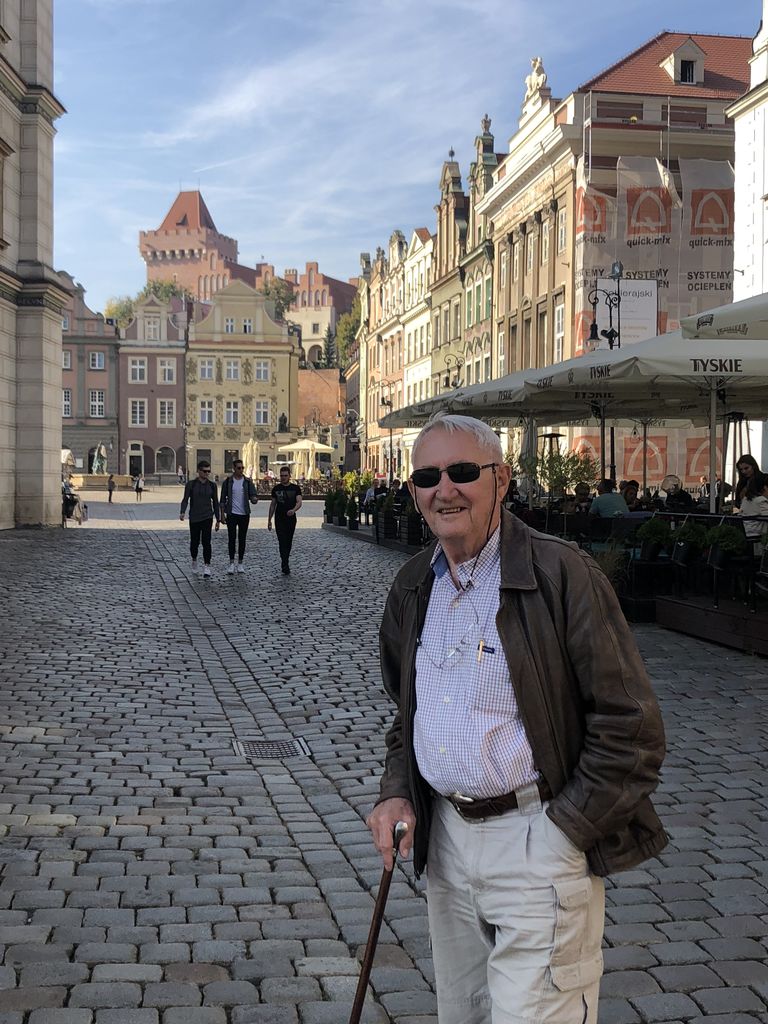
The last chapter. Stan returned to Poland in 2018 and lived in Poznań until a fall in 2022 brought his son Mark to bring him home to Tennessee. In his final years, even as dementia advanced, Mark was constantly trying to gather information about Stan’s life for an upcoming book about him — and was successful in capturing a fair amount of it. Stan saw a near-final draft when he had already lost the ability to speak. He smiled. Mark will finish the book in his honor.
Survivors. Stan is survived by his children — his son, Richard Ernest (Rick) Vaught of Gainesville, Georgia; his son, Mark Andrew Siedlecki of Chattanooga, and Mark’s husband, The Very Rev. Erik Broeren of St. Joseph, Michigan; and his daughter, Jamie Churchill of Rossville, Georgia, her husband Loren, and their son Sean; the mother of his children, his wife of forty years and — in the years following their divorce — his close friend, Mary Elizabeth Sheehan Roser of Chattanooga; his brother, Lt. Col. (Ret.) Marek Stefan Krysiewicz of Olsztyn and his wife Basia; his sister, Maria Magdalena (Magda) Pertyńska of Gdańsk, Poland; his sister, Sophia Siedlecki of Australia; and many nieces, nephews, cousins, and friends across the world. He was preceded in death by his biological father, Stanisław Andrzej Grzymała-Siedlecki III of Melbourne, Australia, for whom he was named; his stepfather, Adam Krysiewicz, who raised him; his mother, Maria Bronisława Szwarc Krysiewicz; his brother, Tomasz (Tomek) Krysiewicz; and his brother, Ludwik Siedlecki of Australia.
A committal service with military honors will be held at Chattanooga National Cemetery on Friday, May 15, 2026, at 1:30 p.m. In lieu of flowers, memorial contributions may be directed to the Alzheimer’s Association, the Kosciuszko Foundation, or the Hoover Institution Library & Archives in support of the Radio Free Europe / Radio Liberty Collection.
— ♦ —
Rest in peace, Tato. Honor to your memory.
Please share your memories and photos of Stan on his online guest register at www.vanderwallfh.com.
The family is being cared for by Vanderwall Funeral Home in Dayton, Tennessee.
Funeral Services for Stanislaw Andrzej Grzymala-Siedlecki IV
Burial

Friday
Chattanooga National Cemetery
Starts at 1:30 pm (Eastern time)
Stanislaw Andrzej Grzymala-Siedlecki IV's Guestbook
Visits: 829
This site is protected by reCAPTCHA and the
Google Privacy Policy and Terms of Service apply.
Service map data © OpenStreetMap contributors